7 Days of Structured Revision + Written Practice = Ace the CBSE Class 12 Chemistry Board Exam
Preparing for the CBSE Class XII Chemistry Board Examination requires more than last-minute revision. It demands structured planning, NCERT alignment, and disciplined written practice.
As a Chemistry mentor, I have designed this 7-Day Revision Plan to help students consolidate concepts, strengthen application skills, and approach the examination with confidence and clarity.
This plan is practical, exam-oriented, and aligned with the CBSE marking scheme.
Why a Structured 7-Day Revision Works
Board examinations assess:
- Conceptual clarity
- Accuracy in chemical equations and numericals
- Proper presentation and structured answers
- Time management
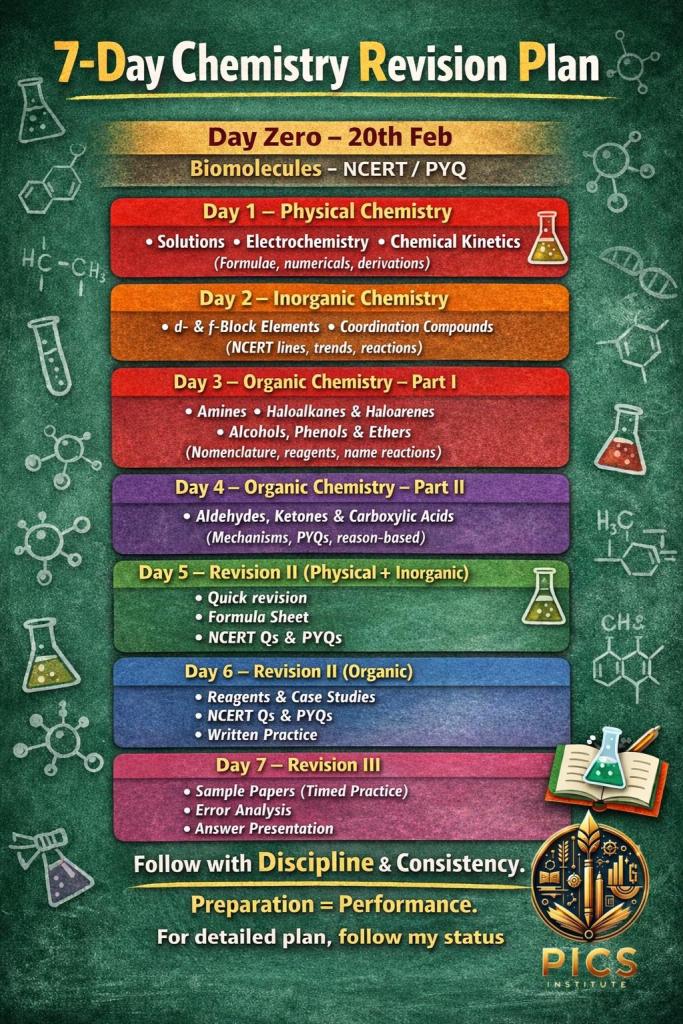
A planned revision schedule eliminates confusion and builds performance consistency.
Day Zero : Biomolecules – NCERT / PYQs
Day 1: Physical Chemistry – Concept & Numerical Precision
Chapters:
- Solutions
- Electrochemistry
- Chemical Kinetics
Focus:
- Important formulae and derivations
- Graph-based questions
- Numerical problem-solving
- Units and significant figures
Physical Chemistry is scoring when formula application is clear and practiced.
Day 2: Inorganic Chemistry – NCERT-Centric Revision
Chapters:
- d- and f-Block Elements
- Coordination Compounds
Focus:
- Oxidation states and trends
- Crystal Field Theory basics
- Important reactions and exceptions
- Line-by-line NCERT revision
Inorganic Chemistry requires memory supported by conceptual understanding.
Day 3: Organic Chemistry – Part I
Chapters:
- Amines
- Haloalkanes and Haloarenes
- Alcohols, Phenols and Ethers
Conceptual Focus:
- Nomenclature
- Organic reagents and their functions
- Name reactions with mechanisms
- Distinguishing tests
- Acidic and basic strength
- Identify A, B, C conversions
- Reason-based questions
Organic Chemistry demands mechanism clarity and structured written answers.
Day 4: Organic Chemistry – Part II
Chapter:
- Aldehydes, Ketones and Carboxylic Acids
Focus:
- Reaction mechanisms
- Name reactions
- Reagent-specific transformations
- Distinguishing tests
- PYQ practice
This chapter frequently carries high weightage in board examinations.
Day 5: Revision II – Physical + Inorganic
Target:
- Quick formula sheet revision
- Important trends and reactions
- NCERT Questions + Previous Year Questions
Reinforcement improves retention and reduces exam anxiety.
Day 6: Revision II – Organic Chemistry
Target:
- Quick revision of reactions
- Functions of reagents
- Case study-based questions
- NCERT Questions + PYQs
Consistent written practice is essential for Organic Chemistry mastery.
Day 7: Revision III – Final Exam Simulation
Focus:
- Solve multiple sample papers under timed conditions
- Analyze errors
- Improve answer presentation
Last-Day Advisory
- Avoid starting new topics
- Revise formulae and key reactions only
- Get adequate sleep
- Stay calm and hydrated
Exam Hall Strategy
- Read the question paper carefully
- Attempt confident sections first
- Write balanced equations clearly
- Underline key terms
- Manage time effectively
The Importance of Written Practice
Many students revise passively. However, board examinations reward structured written expression. Written practice improves:
- Speed
- Accuracy
- Answer presentation
- Confidence
Consistent writing converts knowledge into marks.
Preparation without structure leads to stress. Structured revision builds confidence.
Follow this 7-day plan with discipline, focus on NCERT, practice sincerely, and trust your preparation.
Your effort will reflect in your results.
You will ace the Chemistry examination.
 PICS INSTITUTE - Art Of Teaching