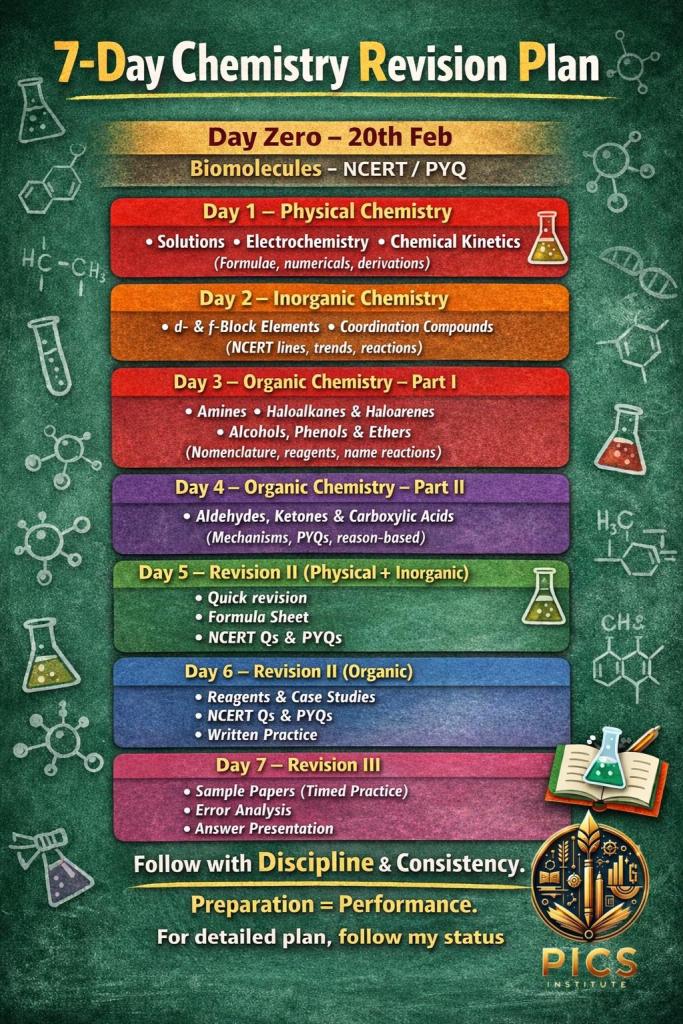
Effective Strategies to Excel in CBSE Class XII Board Exams with Limited Time….

As the CBSE Class XII board exams approach, the last month becomes critical for focused preparation. This is the time to consolidate your knowledge, practice extensively, and fine-tune your exam-taking strategy. With the right approach and discipline, you can significantly improve your performance. Here is a comprehensive plan for excelling in the final month.

1. Prioritize Revision of Core Topics

In the last month, your focus should shift to strengthening key concepts and high-weightage topics.

-Strengthen Weak Areas: Allocate extra time to difficult topics while continuing to revise strong ones.

-Use Summarized Notes: Rely on well-organized notes for quick revision instead of rereading entire textbooks.

2. Practice Sample Papers and Previous Year Papers

One of the most effective ways to prepare is by solving full-length papers under exam conditions.

-Solve at Least One Paper Daily: Time yourself to simulate the actual exam.

-Analyze Your Performance: Identify mistakes and learn from them.

-Understand the Marking Scheme: This helps in presenting answers as per CBSE guidelines, particularly in theoretical subjects.

3. Master Time Management

Effective time management can significantly impact your exam performance.

– Allocate specific time for each section of the paper during practice.

-Learn to identify which questions to attempt first based on your strengths.

-Practice completing the entire paper within the allotted time.

4. Focus on Presentation and Answering Techniques

Your answer presentation can influence your marks.

-Write answers neatly and underline key points.

-Use diagrams wherever possible in subjects like Biology.

-In subjects like Mathematics, present stepwise solutions clearly.

-For long-answer questions in theory subjects, structure answers with an introduction, body, and conclusion.

5. Review NCERT Thoroughly

NCERT textbooks are the primary resource for CBSE exams.

-Ensure that you have read and understood all NCERT chapters thoroughly.

-Solve all NCERT back exercises and examples, especially in Science and Math.

6. Focus on High-Scoring Subjects

In the last month, some subjects can be easier to score with proper attention.

-Chemistry, Mathematics and Physics: Practice problem-solving rigorously.

-English: Prepare writing sections (essays, letters), and practice comprehension passages.

7. Stay Healthy and Maintain a Balanced Routine

A healthy mind is essential for effective preparation.

-Get at least 7-8 hours of sleep daily.

-Avoid junk food; opt for nutritious meals to keep your energy levels high.

-Take short breaks during study sessions to refresh your mind.

8. Avoid Cramming in the Last Few Days

Cramming large amounts of information just before the exam can cause stress and confusion.

-Focus on revising what you already know well.

-Go through your concise notes and key formulas.

9. Manage Stress and Stay Positive

-Practice deep breathing or meditation to reduce anxiety.

-Believe in your preparation and stay confident.

10. Seek Clarifications Promptly

If you are stuck on any topic, reach out to your teachers or friends without delay. Clearing doubts ensures clarity and boosts confidence.

Final Words :

Remember, the last month is about smart revision, consistent practice, and staying calm. Trust your preparation, maintain focus, and give your best effort in every subject. With discipline and determination, success is inevitable.

Wishing you all the very best for your CBSE board exams!

INTRODUCTION TO ORGANIC AGENTS

Organic agents in chemistry refer to substances that are typically composed of carbon-based molecules and are involved in chemical reactions. These agents can act as reactants, catalysts, or intermediates and are fundamental to various fields of chemistry, including organic synthesis, biochemistry, and industrial applications.

1. Classification of Organic Agents

Organic agents are broadly categorized based on their role in chemical reactions:

Reactants: The starting materials in a chemical reaction. For example:

• Hydrocarbons like alkanes, alkenes, and alkynes.

• Compounds with functional groups, such as alcohols, aldehydes, and ketones.

Reagents: Substances used to bring about chemical changes. Examples include:

• Oxidizing agents: Potassium permanganate (KMnO4), chromium trioxide (CrO3).

• Reducing agents: Lithium aluminum hydride (LiAlH4), sodium borohydride (NaBH4).

• Halogenating agents: N-bromosuccinimide (NBS), thionyl chloride (SOCl2).

Catalysts: Molecules that accelerate reactions without being consumed. Examples:

• Enzymes in biochemical reactions (e.g., proteases, lipases).

• Organocatalysts like proline or DMAP (4-dimethylaminopyridine).

Intermediates: Short-lived species formed during a reaction. Examples:

• Carbocations, carbanions, and free radicals.

• Reactive intermediates like enolates and imines.

2. Structure of Organic Agents

The structure of organic agents profoundly impacts their reactivity:

Hydrocarbon frameworks: Alkanes, alkenes, alkynes, and aromatic compounds form the skeleton.

Heteroatoms: Non-carbon atoms (e.g., oxygen, nitrogen, sulfur) introduce polarity and sites for reactivity.

Resonance and Conjugation: Delocalized electrons in systems like benzene or conjugated dienes enhance stability and unique reactivity.

3. Functional Groups and Their Role

Functional groups dictate the chemical behavior of organic agents:

Alcohols (-OH): Act as nucleophiles in substitution reactions or can be oxidized to aldehydes and ketones.

Carboxylic Acids (-COOH): Serve as acids in proton transfer reactions and precursors to esters and amides.

Amines (-NH2): Function as nucleophiles and bases, playing roles in peptide bond formation.

Halides (Cl, Br, I): Participate in substitution and elimination reactions.

4. Mechanisms of Action

Organic agents participate in diverse mechanisms:

Substitution Reactions (SN1/SN2): Involve nucleophiles replacing a leaving group.

Addition Reactions: Add atoms or groups to unsaturated molecules (e.g., alkenes to alkanes).

Elimination Reactions (E1/E2): Remove atoms or groups to form double bonds.

Oxidation and Reduction: Exchange of electrons or changes in oxidation state.

Pericyclic Reactions: Concerted processes like cycloadditions or sigmatropic shifts.

5. Organic Agents in Biochemical Systems

Organic agents are essential in biological processes:

Metabolic Pathways: Enzymes catalyze reactions involving organic substrates (e.g., glucose oxidation in glycolysis).

Pharmaceuticals: Organic molecules such as aspirin and antibiotics interact with biological targets.

Coenzymes: Organic molecules like NAD+ and FAD act as redox agents in metabolism.

6. Applications of Organic Agents

Organic agents are widely used in various fields:

Industrial Chemistry: Production of plastics (polyethylene, polystyrene), synthetic fibers (nylon), and rubber.

Pharmaceuticals: Organic agents are the backbone of drugs, including antibiotics, analgesics, and antivirals.

Agriculture: Development of pesticides, herbicides, and fertilizers.

Energy: Fuels like gasoline, biodiesel, and ethanol are organic compounds.

7. Emerging Trends

Organic chemistry is evolving with new agents and techniques:

Green Chemistry: Development of eco-friendly organic agents and processes to reduce environmental impact.

Biocatalysis: Use of enzymes and genetically engineered organisms to produce organic compounds.

Organic Electronics: Organic semiconductors for flexible and lightweight electronic devices.

In summary, organic agents are a cornerstone of chemistry, with diverse roles ranging from simple molecules in basic reactions to complex systems in industrial and biological contexts. Their study is essential for advancing scientific and technological frontiers.

POWER OF POSITIVE MINDSET…

The power of a positive mindset is significant, not just because it makes us feel good, but because it genuinely shapes how we perceive and interact with the world. A positive mindset influences everything from our physical health and mental well-being to our productivity and relationships. Here’s a breakdown of the impact it can have and ways to cultivate it:

1. Improves Mental Health

• A positive mindset helps reduce stress and anxiety. When we focus on the good, we’re less likely to be overwhelmed by negative thoughts.

• Optimism is often linked to greater resilience, enabling us to bounce back from setbacks more effectively.

• Research shows that positivity can boost serotonin and dopamine levels, which are natural mood enhancers.

2. Boosts Physical Health

• The mind and body are deeply connected; when we focus on positive thoughts, our body responds. For example, positivity can boost immune function and lower blood pressure.

• Positive people are more likely to adopt healthy habits and stick to them, which leads to improved long-term physical health.

3. Increases Productivity and Creativity

• Positive thinking opens up our minds, allowing for more creativity and problem-solving abilities. It helps us stay motivated, persist longer, and look for solutions rather than seeing obstacles.

• Studies show that when people are in a positive frame of mind, they are more productive and make more creative connections.

4. Improves Relationships

• People are naturally drawn to positive individuals, making it easier to build connections and foster relationships. Positivity also makes us more empathetic and open-minded, which improves communication and trust.

• Positive thinking encourages forgiveness and patience, two qualities essential for maintaining strong relationships.

5. Promotes Success and Goal Achievement

• A positive mindset is key to self-confidence. When we believe in ourselves, we’re more likely to take risks and set higher goals, leading to greater achievement.

• Positivity encourages a growth mindset, where we see challenges as learning opportunities. This outlook is invaluable for personal and professional growth.

How to Cultivate a Positive Mindset

Practice Gratitude: Regularly reflect on what you’re grateful for, which can shift your focus to the positive aspects of your life.

Surround Yourself with Positivity: Spend time with people who uplift and inspire you, and engage in activities that bring you joy.

Reframe Negative Thoughts: Challenge negative thoughts by reframing them into more constructive ones. For example, instead of “I’m bad at this,” try, “I can learn and improve with practice.”

Set and Celebrate Small Goals: Achieving small goals builds momentum and creates a sense of accomplishment that fuels positivity.

Mindfulness and Meditation: These practices help increase self-awareness and manage stress, making it easier to stay positive in difficult situations.

A positive mindset isn’t about ignoring life’s difficulties; it’s about facing them with resilience, optimism, and the belief that we can grow through them.

How to Find out Limiting Reactant for JEE & NEET

Limiting Reactant in Chemical Reactions

In chemical reactions, the concept of the limiting reactant (or limiting reagent) is essential for understanding how reactions proceed and how products are formed. This topic is critical for students preparing for competitive exams like JEE and NEET. Here is a detailed explanation suitable for Class 11 Chemistry.

Definition of Limiting Reactant

The limiting reactant is the substance that is completely consumed first in a chemical reaction, thereby determining the maximum amount of product that can be formed. Once the limiting reactant is used up, the reaction cannot proceed further, even if other reactants are still available.

Identifying the Limiting Reactant

To identify the limiting reactant in a chemical reaction, follow these steps:

  1. Write a balanced chemical equation: Ensure the reaction equation is balanced to reflect the conservation of mass and the stoichiometry of the reaction.
  2. Convert given quantities to moles: Use molar masses to convert the masses of reactants to moles, as stoichiometric calculations are based on mole ratios.
  3. Calculate the mole ratio: Determine the mole ratio of the reactants from the balanced equation and compare it with the ratio of moles of reactants provided.
  4. Identify the limiting reactant: The reactant that has the smaller ratio (actual moles to required moles) is the limiting reactant. Example

Importance of Limiting Reactant

Understanding the limiting reactant is crucial because:

  • It allows for the calculation of the theoretical yield of products.
  • It ensures efficient use of reactants, minimizing waste.
  • It is fundamental in industrial applications where cost efficiency is essential.

Practical Applications

  • Industrial Chemistry: In manufacturing processes, knowing the limiting reactant helps in optimizing the use of raw materials and improving yield.
  • Pharmaceuticals: The production of drugs requires precise stoichiometric calculations to ensure the correct dosage and efficacy.
  • Environmental Science: Managing pollutants often involves reactions where controlling the limiting reactant can minimize harmfulness.
    Conclusion

The concept of the limiting reactant is a cornerstone in stoichiometry, providing insights into the amounts of products formed in chemical reactions. Mastering this topic is vital for success in competitive exams like JEE and NEET, as it lays the foundation for more advanced chemical calculations and practical applications in various scientific fields.

Best Discount on Video lecture course for JEEmains & NEET 2025

!! Do You wanna 1 of the 67 Rank -1 Holder in NEET next year !! Chemistry is the Key Subject for getting Top Rank in JEE and NEET .Unlock Your Chemistry Potential! 🧪✨Ace NEET, JEE, and CBSE exams with our comprehensive video lecture course!✅ Expert Instructors-Learn from top educators.✅ In-Depth Content-Covers all essential topics.✅ Flexible Learning-Study at your own pace, anytime, anywhere.✅ Interactive Quizzes-Test your knowledge and track your progress.✅ Affordable Pricing-Quality education at an unbeatable price.🎓 Join thousands of successful students today!🌐 Enroll Now- View this item on WhatsApp: https://wa.me/p/4416479638466252/919416388045‎Description: Chemistry for JEEmains , NEET and CBSE for class 11 or 12.📞 Contact Us – 8076847377 , 9416388045#NEET #JEE #CBSE #ChemistryCourse #Education #OnlineLearning #videolecturecourse

Full Organic Chemistry videos

Dear Students , Here Publishing playlist of “#FULL_ORGANIC_CHEMISTRY” For CLASS-12

Chemistry.

“support my mission of “#FreeEducation” by attaching more and more students to our channel for upliftment of our #Education_System

Click here for Full Organic Chemistry

Live revision classes – 1st Time in India

#chemistryClasses #NEET #JEE #XII #XI

For our Subscribers only.

Free Education for NEET , JEE , XII , XI

#Free #Education #मुफ़्त #शिक्षा

Our youTube channel –

1.Full video on chemistry – pics4iit

https://www.youtube.com/user/pics4iit

2. Our Notes Only channel – PICS EDUPLEX

https://www.youtube.com/channel/UCO9Mu5JpCO-i7XIANoe5vcw

3. Our channel in English language for Chemistry – Chemistry Guru ji-

https://www.youtube.com/channel/UC-ojOrE7ZaaPy4Posfw4Hng

4.Free worksheets on Instagram – pics_Institute