
Organic agents in chemistry refer to substances that are typically composed of carbon-based molecules and are involved in chemical reactions. These agents can act as reactants, catalysts, or intermediates and are fundamental to various fields of chemistry, including organic synthesis, biochemistry, and industrial applications.
1. Classification of Organic Agents
Organic agents are broadly categorized based on their role in chemical reactions:
• Reactants: The starting materials in a chemical reaction. For example:
• Hydrocarbons like alkanes, alkenes, and alkynes.
• Compounds with functional groups, such as alcohols, aldehydes, and ketones.
• Reagents: Substances used to bring about chemical changes. Examples include:
• Oxidizing agents: Potassium permanganate (KMnO4), chromium trioxide (CrO3).
• Reducing agents: Lithium aluminum hydride (LiAlH4), sodium borohydride (NaBH4).
• Halogenating agents: N-bromosuccinimide (NBS), thionyl chloride (SOCl2).
• Catalysts: Molecules that accelerate reactions without being consumed. Examples:
• Enzymes in biochemical reactions (e.g., proteases, lipases).
• Organocatalysts like proline or DMAP (4-dimethylaminopyridine).
• Intermediates: Short-lived species formed during a reaction. Examples:
• Carbocations, carbanions, and free radicals.
• Reactive intermediates like enolates and imines.
2. Structure of Organic Agents
The structure of organic agents profoundly impacts their reactivity:
• Hydrocarbon frameworks: Alkanes, alkenes, alkynes, and aromatic compounds form the skeleton.
• Heteroatoms: Non-carbon atoms (e.g., oxygen, nitrogen, sulfur) introduce polarity and sites for reactivity.
• Resonance and Conjugation: Delocalized electrons in systems like benzene or conjugated dienes enhance stability and unique reactivity.
3. Functional Groups and Their Role
Functional groups dictate the chemical behavior of organic agents:
• Alcohols (-OH): Act as nucleophiles in substitution reactions or can be oxidized to aldehydes and ketones.
• Carboxylic Acids (-COOH): Serve as acids in proton transfer reactions and precursors to esters and amides.
• Amines (-NH2): Function as nucleophiles and bases, playing roles in peptide bond formation.
• Halides (Cl, Br, I): Participate in substitution and elimination reactions.
4. Mechanisms of Action
Organic agents participate in diverse mechanisms:
• Substitution Reactions (SN1/SN2): Involve nucleophiles replacing a leaving group.
• Addition Reactions: Add atoms or groups to unsaturated molecules (e.g., alkenes to alkanes).
• Elimination Reactions (E1/E2): Remove atoms or groups to form double bonds.
• Oxidation and Reduction: Exchange of electrons or changes in oxidation state.
• Pericyclic Reactions: Concerted processes like cycloadditions or sigmatropic shifts.
5. Organic Agents in Biochemical Systems
Organic agents are essential in biological processes:
• Metabolic Pathways: Enzymes catalyze reactions involving organic substrates (e.g., glucose oxidation in glycolysis).
• Pharmaceuticals: Organic molecules such as aspirin and antibiotics interact with biological targets.
• Coenzymes: Organic molecules like NAD+ and FAD act as redox agents in metabolism.
6. Applications of Organic Agents
Organic agents are widely used in various fields:
• Industrial Chemistry: Production of plastics (polyethylene, polystyrene), synthetic fibers (nylon), and rubber.
• Pharmaceuticals: Organic agents are the backbone of drugs, including antibiotics, analgesics, and antivirals.
• Agriculture: Development of pesticides, herbicides, and fertilizers.
• Energy: Fuels like gasoline, biodiesel, and ethanol are organic compounds.
7. Emerging Trends
Organic chemistry is evolving with new agents and techniques:
• Green Chemistry: Development of eco-friendly organic agents and processes to reduce environmental impact.
• Biocatalysis: Use of enzymes and genetically engineered organisms to produce organic compounds.
• Organic Electronics: Organic semiconductors for flexible and lightweight electronic devices.
In summary, organic agents are a cornerstone of chemistry, with diverse roles ranging from simple molecules in basic reactions to complex systems in industrial and biological contexts. Their study is essential for advancing scientific and technological frontiers.




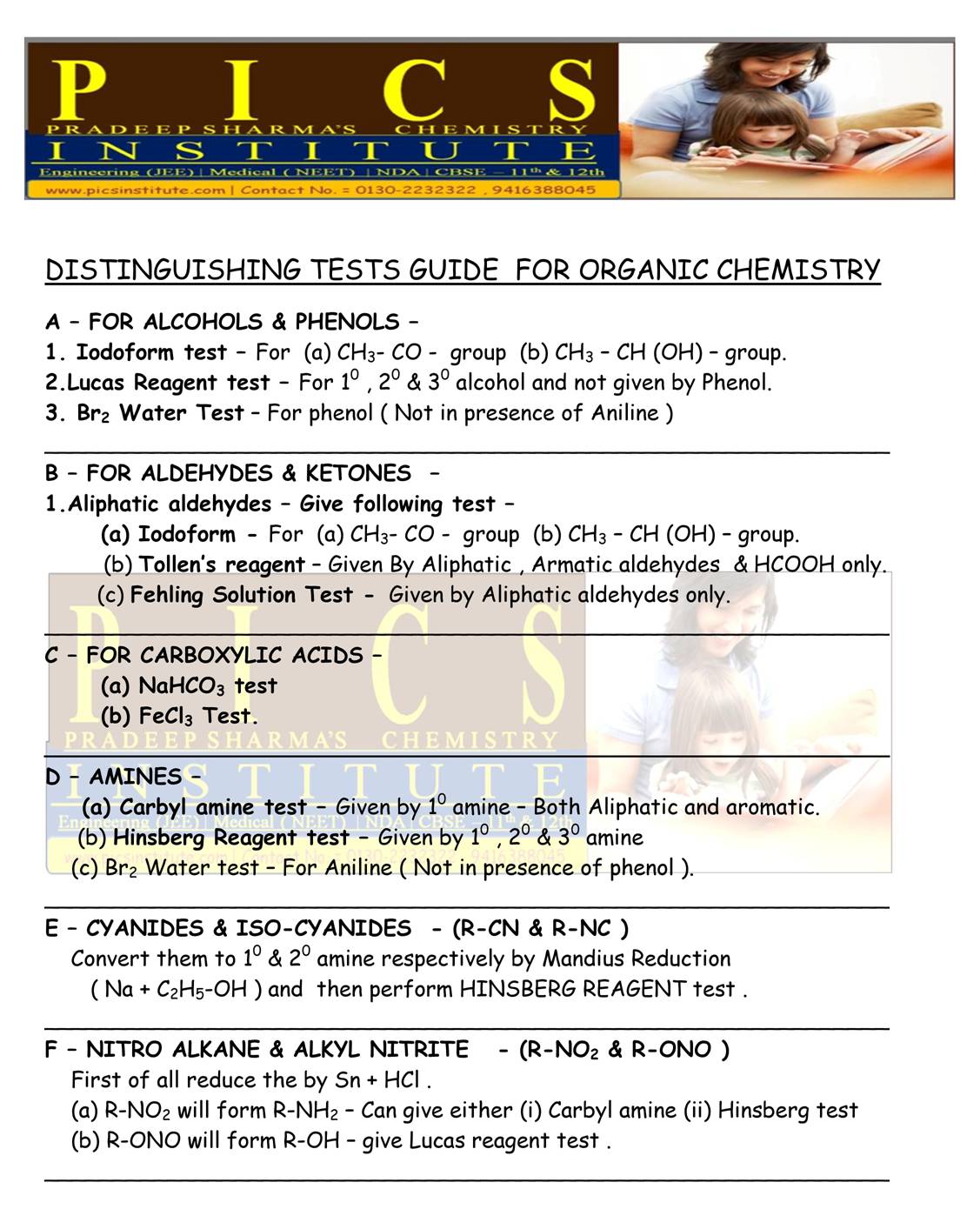
 PICS INSTITUTE - Art Of Teaching