INTRODUCTION TO ORGANIC AGENTS

Organic agents in chemistry refer to substances that are typically composed of carbon-based molecules and are involved in chemical reactions. These agents can act as reactants, catalysts, or intermediates and are fundamental to various fields of chemistry, including organic synthesis, biochemistry, and industrial applications.

1. Classification of Organic Agents

Organic agents are broadly categorized based on their role in chemical reactions:

Reactants: The starting materials in a chemical reaction. For example:

• Hydrocarbons like alkanes, alkenes, and alkynes.

• Compounds with functional groups, such as alcohols, aldehydes, and ketones.

Reagents: Substances used to bring about chemical changes. Examples include:

• Oxidizing agents: Potassium permanganate (KMnO4), chromium trioxide (CrO3).

• Reducing agents: Lithium aluminum hydride (LiAlH4), sodium borohydride (NaBH4).

• Halogenating agents: N-bromosuccinimide (NBS), thionyl chloride (SOCl2).

Catalysts: Molecules that accelerate reactions without being consumed. Examples:

• Enzymes in biochemical reactions (e.g., proteases, lipases).

• Organocatalysts like proline or DMAP (4-dimethylaminopyridine).

Intermediates: Short-lived species formed during a reaction. Examples:

• Carbocations, carbanions, and free radicals.

• Reactive intermediates like enolates and imines.

2. Structure of Organic Agents

The structure of organic agents profoundly impacts their reactivity:

Hydrocarbon frameworks: Alkanes, alkenes, alkynes, and aromatic compounds form the skeleton.

Heteroatoms: Non-carbon atoms (e.g., oxygen, nitrogen, sulfur) introduce polarity and sites for reactivity.

Resonance and Conjugation: Delocalized electrons in systems like benzene or conjugated dienes enhance stability and unique reactivity.

3. Functional Groups and Their Role

Functional groups dictate the chemical behavior of organic agents:

Alcohols (-OH): Act as nucleophiles in substitution reactions or can be oxidized to aldehydes and ketones.

Carboxylic Acids (-COOH): Serve as acids in proton transfer reactions and precursors to esters and amides.

Amines (-NH2): Function as nucleophiles and bases, playing roles in peptide bond formation.

Halides (Cl, Br, I): Participate in substitution and elimination reactions.

4. Mechanisms of Action

Organic agents participate in diverse mechanisms:

Substitution Reactions (SN1/SN2): Involve nucleophiles replacing a leaving group.

Addition Reactions: Add atoms or groups to unsaturated molecules (e.g., alkenes to alkanes).

Elimination Reactions (E1/E2): Remove atoms or groups to form double bonds.

Oxidation and Reduction: Exchange of electrons or changes in oxidation state.

Pericyclic Reactions: Concerted processes like cycloadditions or sigmatropic shifts.

5. Organic Agents in Biochemical Systems

Organic agents are essential in biological processes:

Metabolic Pathways: Enzymes catalyze reactions involving organic substrates (e.g., glucose oxidation in glycolysis).

Pharmaceuticals: Organic molecules such as aspirin and antibiotics interact with biological targets.

Coenzymes: Organic molecules like NAD+ and FAD act as redox agents in metabolism.

6. Applications of Organic Agents

Organic agents are widely used in various fields:

Industrial Chemistry: Production of plastics (polyethylene, polystyrene), synthetic fibers (nylon), and rubber.

Pharmaceuticals: Organic agents are the backbone of drugs, including antibiotics, analgesics, and antivirals.

Agriculture: Development of pesticides, herbicides, and fertilizers.

Energy: Fuels like gasoline, biodiesel, and ethanol are organic compounds.

7. Emerging Trends

Organic chemistry is evolving with new agents and techniques:

Green Chemistry: Development of eco-friendly organic agents and processes to reduce environmental impact.

Biocatalysis: Use of enzymes and genetically engineered organisms to produce organic compounds.

Organic Electronics: Organic semiconductors for flexible and lightweight electronic devices.

In summary, organic agents are a cornerstone of chemistry, with diverse roles ranging from simple molecules in basic reactions to complex systems in industrial and biological contexts. Their study is essential for advancing scientific and technological frontiers.

Full Organic Chemistry videos

Dear Students , Here Publishing playlist of “#FULL_ORGANIC_CHEMISTRY” For CLASS-12

Chemistry.

“support my mission of “#FreeEducation” by attaching more and more students to our channel for upliftment of our #Education_System

Click here for Full Organic Chemistry

Live revision classes – 1st Time in India

#chemistryClasses #NEET #JEE #XII #XI

For our Subscribers only.

Results – Class XII CBSE Boards – 2015-2016

Like every year PICS INSTITUTE give city topper , with 100% results & again proved that PICS is TOP Coaching institute for chemistry education in sonipat , delhi NCR , Haryana.

We provide chemistry education for #JEE #AIPMT #NEET #CBSE #classXII # ClassXI #NDA #NTSE.

IMG_2200

How to get success ?

Success is hard to define , nobody can ever understand it’s true law ….every successful person has different story to tell… And always a question persist – how can I get success ?…I personally

 has my own limitations….can’t give you a formula of success …but from the whatever experience I possess I can surely say .. My own Hypothesis – 

“Managing every second of your time , we can manage our success ”

…”Time management is directly proportional to success ” 


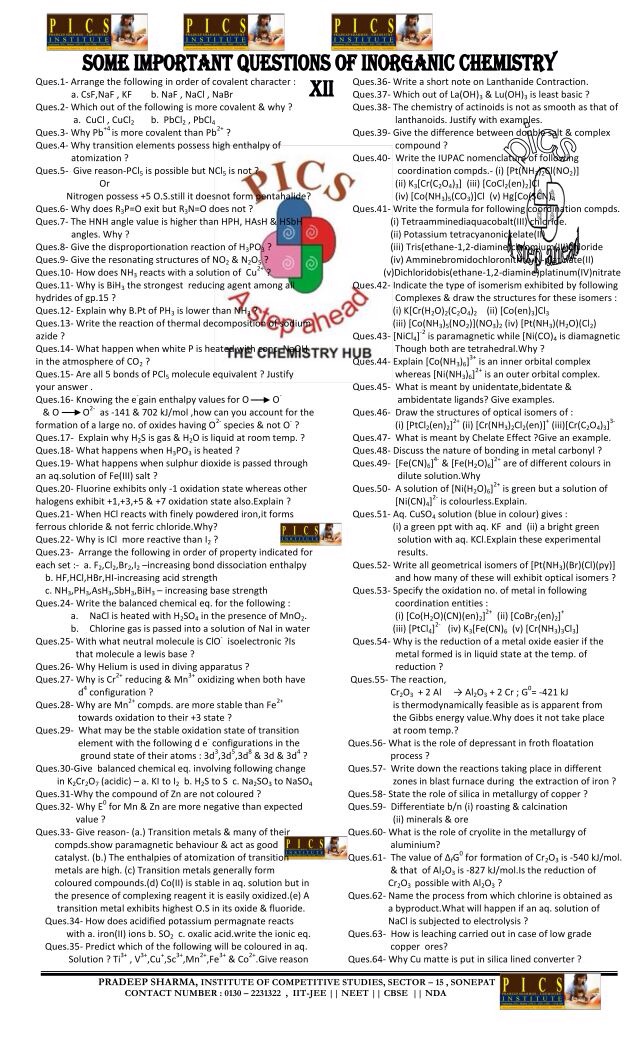
Inorganic chemistry – by PICS INSTITUTE

PICS INSTITUTE is publishing important questions of inorganic chemistry for class XII.

IMG_7657

Open text based assessment (OTBA) , another missile for education ?

So called the bosses of education always try to make education more unrealistic .
Previously CBSE decides to introduce SA and FA system , which is a fatal system for education . I saw lots of students with low efficiency due to this system .
How can Government introduce this system upto class 10 level , when our competitive exams like IIT-JEE , NEET , NDA etc involve syllabus of full two years in each subject ?
The previous SA and FA system decreases the efficiency of our students .
Now Big Bosses of education trying to implement OTBA( open text based assessment ) , another disaster for education . This will totally make our student handicapped from memory point of view. Their mode of work will change and they will always search for helping material .
Our entrance exams are not open text based . How we can think about generating genius students ? Instead we get Parasitic one .
Education policies should be made by taking views of those who are in direct contact of education and not by only psychologists or policies maker , who are far away from ground realities .

For class XII – CBSE board exams … Mock test – Aldehyse , ketones and carboxylic acids.

For class XII – CBSE board exams … Mock test – Aldehyse , ketones and carboxylic acids.

Is it good for students to prepare for IIT-JEE and NEET from 9th and 10th class ?

Now a days I am very closely observing such students who are forced to do study 1-2 step ahead than their actual level .
Results are not as expected .
Few questions arise –
(A) can it be helpful to start preparing for JEE and PMT at 9th level?
(B) what type of strategies should a student follow for better results ?
(C) What my friends say , if I not force my child for JEE at 9th level ?

In my views – it is the utmost duty of parents to follow child oriented parenting and not the disable parenting .
Decision for our child should be for the development of our child and not for satisfying our ego.
All kids are not meant for JEE and PMT.
There are large number of options other than engineering and medical branch.
9th and 10 classes should be used for laying strong foundations , by encouraging students for NTSE and KVPY . This will develop a sense of competitiveness among a child .
“One step ahead ” method is good I.e. In 9th along with 9th class syllabus a student can effectively prepare 10 class syllabus. In this manner he can step up without loosing pace and his interest in studies .
Long jumps at 9th and 10 level can be disastrous.
I request all the parents to guide you child according to his/ her capabilities and not for satisfying your ego.
Always remember- “step by step you gone ahead and come some very fast “.