7 days Power revision plan for chemistry Board Exam

7 Days of Structured Revision + Written Practice = Ace the CBSE Class 12 Chemistry Board Exam

Preparing for the CBSE Class XII Chemistry Board Examination requires more than last-minute revision. It demands structured planning, NCERT alignment, and disciplined written practice.

As a Chemistry mentor, I have designed this 7-Day Revision Plan to help students consolidate concepts, strengthen application skills, and approach the examination with confidence and clarity.

This plan is practical, exam-oriented, and aligned with the CBSE marking scheme.

Why a Structured 7-Day Revision Works

Board examinations assess:

  • Conceptual clarity
  • Accuracy in chemical equations and numericals
  • Proper presentation and structured answers
  • Time management

A planned revision schedule eliminates confusion and builds performance consistency.

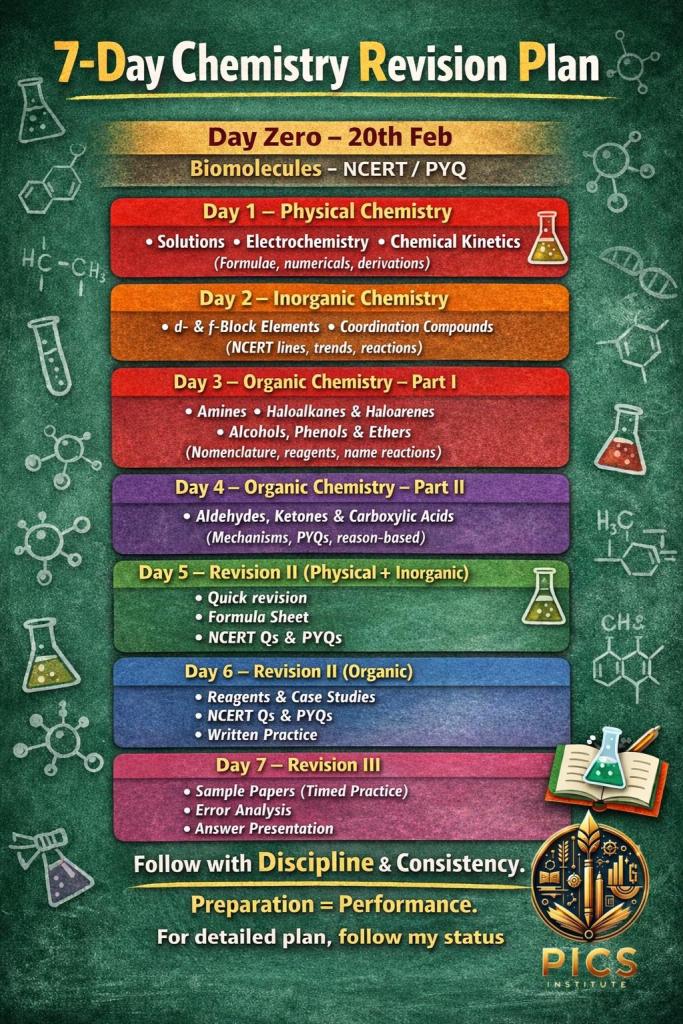
Day Zero : Biomolecules – NCERT / PYQs

Day 1: Physical Chemistry – Concept & Numerical Precision

Chapters:

  • Solutions
  • Electrochemistry
  • Chemical Kinetics

Focus:

  • Important formulae and derivations
  • Graph-based questions
  • Numerical problem-solving
  • Units and significant figures

Physical Chemistry is scoring when formula application is clear and practiced.

Day 2: Inorganic Chemistry – NCERT-Centric Revision

Chapters:

  • d- and f-Block Elements
  • Coordination Compounds

Focus:

  • Oxidation states and trends
  • Crystal Field Theory basics
  • Important reactions and exceptions
  • Line-by-line NCERT revision

Inorganic Chemistry requires memory supported by conceptual understanding.

Day 3: Organic Chemistry – Part I

Chapters:

  • Amines
  • Haloalkanes and Haloarenes
  • Alcohols, Phenols and Ethers

Conceptual Focus:

  • Nomenclature
  • Organic reagents and their functions
  • Name reactions with mechanisms
  • Distinguishing tests
  • Acidic and basic strength
  • Identify A, B, C conversions
  • Reason-based questions

Organic Chemistry demands mechanism clarity and structured written answers.

Day 4: Organic Chemistry – Part II

Chapter:

  • Aldehydes, Ketones and Carboxylic Acids

Focus:

  • Reaction mechanisms
  • Name reactions
  • Reagent-specific transformations
  • Distinguishing tests
  • PYQ practice

This chapter frequently carries high weightage in board examinations.

Day 5: Revision II – Physical + Inorganic

Target:

  • Quick formula sheet revision
  • Important trends and reactions
  • NCERT Questions + Previous Year Questions

Reinforcement improves retention and reduces exam anxiety.

Day 6: Revision II – Organic Chemistry

Target:

  • Quick revision of reactions
  • Functions of reagents
  • Case study-based questions
  • NCERT Questions + PYQs

Consistent written practice is essential for Organic Chemistry mastery.

Day 7: Revision III – Final Exam Simulation

Focus:

  • Solve multiple sample papers under timed conditions
  • Analyze errors
  • Improve answer presentation

Last-Day Advisory

  • Avoid starting new topics
  • Revise formulae and key reactions only
  • Get adequate sleep
  • Stay calm and hydrated

Exam Hall Strategy

  • Read the question paper carefully
  • Attempt confident sections first
  • Write balanced equations clearly
  • Underline key terms
  • Manage time effectively

The Importance of Written Practice

Many students revise passively. However, board examinations reward structured written expression. Written practice improves:

  • Speed
  • Accuracy
  • Answer presentation
  • Confidence

Consistent writing converts knowledge into marks.

Preparation without structure leads to stress. Structured revision builds confidence.

Follow this 7-day plan with discipline, focus on NCERT, practice sincerely, and trust your preparation.

Your effort will reflect in your results.

You will ace the Chemistry examination.
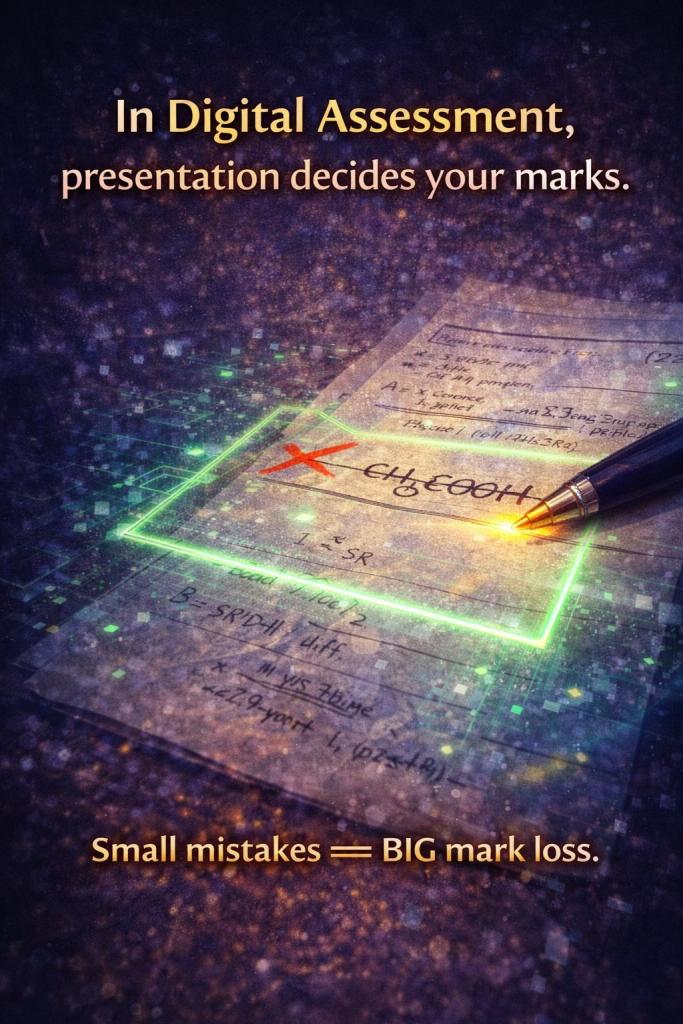
Mastering the CBSE Class 12 Digital Assessment: 7 Smart Precautions for Every Student

As the CBSE Board moves toward a more tech-driven future, the Class 12 On-Screen Marking (OSM) system has changed the game. While you still write your exam on physical paper, your answer sheet is now scanned and evaluated digitally by examiners on a computer screen.

At PICS Institute, we believe that even the best preparation in Chemistry can be undercut by poor presentation. To ensure “Technology sees your hard work clearly,” here is your ultimate guide to the smart precautions you must take during your digital assessment.

1. The Ink Matters: Stick to Dark Blue or Black

When a computer scans your paper, light or “faded” ink can become illegible.

• The Rule: Use only dark blue or black ballpoint or gel pens.

• PICS Tip: Avoid using glitter pens or very light blue ink. High-contrast writing ensures that every “electron dot structure” or “chemical equation” you write is crystal clear for the digital examiner.

2. Legibility is King (No More Cursive Confusion)

In a digital scan, letters that are too close together or overly stylized cursive can look like a blur.

• The Precaution: Write clearly and legibly. Leave adequate spacing between words and lines.

• Why? An examiner can zoom in on a digital screen, but they can’t “guess” what a word is if the scan is pixelated.

3. Precision in Diagrams

Chemistry is a subject of structures. Whether it’s the p-block elements or Organic Reaction Mechanisms, your diagrams must be sharp.

• The Precaution: Use a sharp pencil and a ruler for all diagrams. Label them horizontally so the examiner doesn’t have to “rotate” their screen to read your text.

• Pro-Tip: Ensure your arrows in reaction mechanisms are distinct. A “half-headed” arrow vs. a “full-headed” arrow determines your marks in Organic Chemistry!

4. Follow Question Numbering Strictly

The digital evaluation software often aligns the examiner’s marking grid with the question numbers.

• The Precaution: Never skip or mix up question numbers. Write the Question Number prominently in the margin.

• The Risk: If you mislabel a 5-mark question as a 3-mark one, it can create confusion in the digital marking portal.

5. Structure with Points, Not Paragraphs

Reading long paragraphs on a computer screen is tiring for examiners.

• The Precaution: Attempt your answers in structured, numbered points. Use bullet points for properties, uses, and definitions.

• The Benefit: It makes it easier for the examiner to spot the “Value Points” (keywords) and award marks instantly.

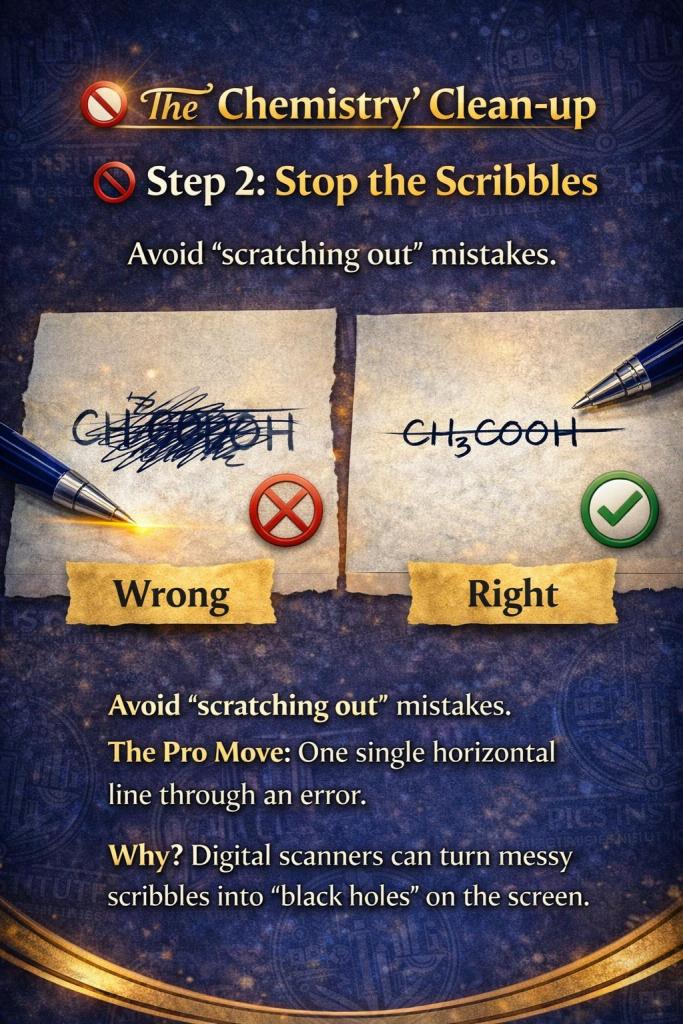
6. Avoid Unnecessary “Cutting” and Scribbling

In the physical world, a messy page looks bad. In a digital scan, a large “scribble” or “over-writing” can create a dark blotch that hides the text around it.

• The Precaution: If you make a mistake, simply draw a single horizontal line through it. Avoid “scratching out” or using whitener, which can sometimes create glare during scanning.

7. The 15-Minute Review Rule

Time management is different when you have to ensure “scan-ability.”

• The Precaution: Manage your time wisely to save 10–15 minutes at the end.

• The Checklist: Check if your roll number is clear, ensure no page is left blank in between, and make sure all chemical formulas are written with proper subscripts

Final Thoughts from PICS Institute

Digital assessment is designed to make evaluation error-free and faster. By following these “Smart Precautions,” you ensure that the technology works for you, not against you.

Remember: “Present your best… Let technology see it clearly!”

Are you ready to ace your Chemistry Boards? 

Join PICS Institute for 27 years of academic excellence and expert guidance.

INTRODUCTION TO ORGANIC AGENTS

Organic agents in chemistry refer to substances that are typically composed of carbon-based molecules and are involved in chemical reactions. These agents can act as reactants, catalysts, or intermediates and are fundamental to various fields of chemistry, including organic synthesis, biochemistry, and industrial applications.

1. Classification of Organic Agents

Organic agents are broadly categorized based on their role in chemical reactions:

Reactants: The starting materials in a chemical reaction. For example:

• Hydrocarbons like alkanes, alkenes, and alkynes.

• Compounds with functional groups, such as alcohols, aldehydes, and ketones.

Reagents: Substances used to bring about chemical changes. Examples include:

• Oxidizing agents: Potassium permanganate (KMnO4), chromium trioxide (CrO3).

• Reducing agents: Lithium aluminum hydride (LiAlH4), sodium borohydride (NaBH4).

• Halogenating agents: N-bromosuccinimide (NBS), thionyl chloride (SOCl2).

Catalysts: Molecules that accelerate reactions without being consumed. Examples:

• Enzymes in biochemical reactions (e.g., proteases, lipases).

• Organocatalysts like proline or DMAP (4-dimethylaminopyridine).

Intermediates: Short-lived species formed during a reaction. Examples:

• Carbocations, carbanions, and free radicals.

• Reactive intermediates like enolates and imines.

2. Structure of Organic Agents

The structure of organic agents profoundly impacts their reactivity:

Hydrocarbon frameworks: Alkanes, alkenes, alkynes, and aromatic compounds form the skeleton.

Heteroatoms: Non-carbon atoms (e.g., oxygen, nitrogen, sulfur) introduce polarity and sites for reactivity.

Resonance and Conjugation: Delocalized electrons in systems like benzene or conjugated dienes enhance stability and unique reactivity.

3. Functional Groups and Their Role

Functional groups dictate the chemical behavior of organic agents:

Alcohols (-OH): Act as nucleophiles in substitution reactions or can be oxidized to aldehydes and ketones.

Carboxylic Acids (-COOH): Serve as acids in proton transfer reactions and precursors to esters and amides.

Amines (-NH2): Function as nucleophiles and bases, playing roles in peptide bond formation.

Halides (Cl, Br, I): Participate in substitution and elimination reactions.

4. Mechanisms of Action

Organic agents participate in diverse mechanisms:

Substitution Reactions (SN1/SN2): Involve nucleophiles replacing a leaving group.

Addition Reactions: Add atoms or groups to unsaturated molecules (e.g., alkenes to alkanes).

Elimination Reactions (E1/E2): Remove atoms or groups to form double bonds.

Oxidation and Reduction: Exchange of electrons or changes in oxidation state.

Pericyclic Reactions: Concerted processes like cycloadditions or sigmatropic shifts.

5. Organic Agents in Biochemical Systems

Organic agents are essential in biological processes:

Metabolic Pathways: Enzymes catalyze reactions involving organic substrates (e.g., glucose oxidation in glycolysis).

Pharmaceuticals: Organic molecules such as aspirin and antibiotics interact with biological targets.

Coenzymes: Organic molecules like NAD+ and FAD act as redox agents in metabolism.

6. Applications of Organic Agents

Organic agents are widely used in various fields:

Industrial Chemistry: Production of plastics (polyethylene, polystyrene), synthetic fibers (nylon), and rubber.

Pharmaceuticals: Organic agents are the backbone of drugs, including antibiotics, analgesics, and antivirals.

Agriculture: Development of pesticides, herbicides, and fertilizers.

Energy: Fuels like gasoline, biodiesel, and ethanol are organic compounds.

7. Emerging Trends

Organic chemistry is evolving with new agents and techniques:

Green Chemistry: Development of eco-friendly organic agents and processes to reduce environmental impact.

Biocatalysis: Use of enzymes and genetically engineered organisms to produce organic compounds.

Organic Electronics: Organic semiconductors for flexible and lightweight electronic devices.

In summary, organic agents are a cornerstone of chemistry, with diverse roles ranging from simple molecules in basic reactions to complex systems in industrial and biological contexts. Their study is essential for advancing scientific and technological frontiers.

Full Organic Chemistry videos

Dear Students , Here Publishing playlist of “#FULL_ORGANIC_CHEMISTRY” For CLASS-12

Chemistry.

“support my mission of “#FreeEducation” by attaching more and more students to our channel for upliftment of our #Education_System

Click here for Full Organic Chemistry

Live revision classes – 1st Time in India

#chemistryClasses #NEET #JEE #XII #XI

For our Subscribers only.

Results – Class XII CBSE Boards – 2015-2016

Like every year PICS INSTITUTE give city topper , with 100% results & again proved that PICS is TOP Coaching institute for chemistry education in sonipat , delhi NCR , Haryana.

We provide chemistry education for #JEE #AIPMT #NEET #CBSE #classXII # ClassXI #NDA #NTSE.

IMG_2200